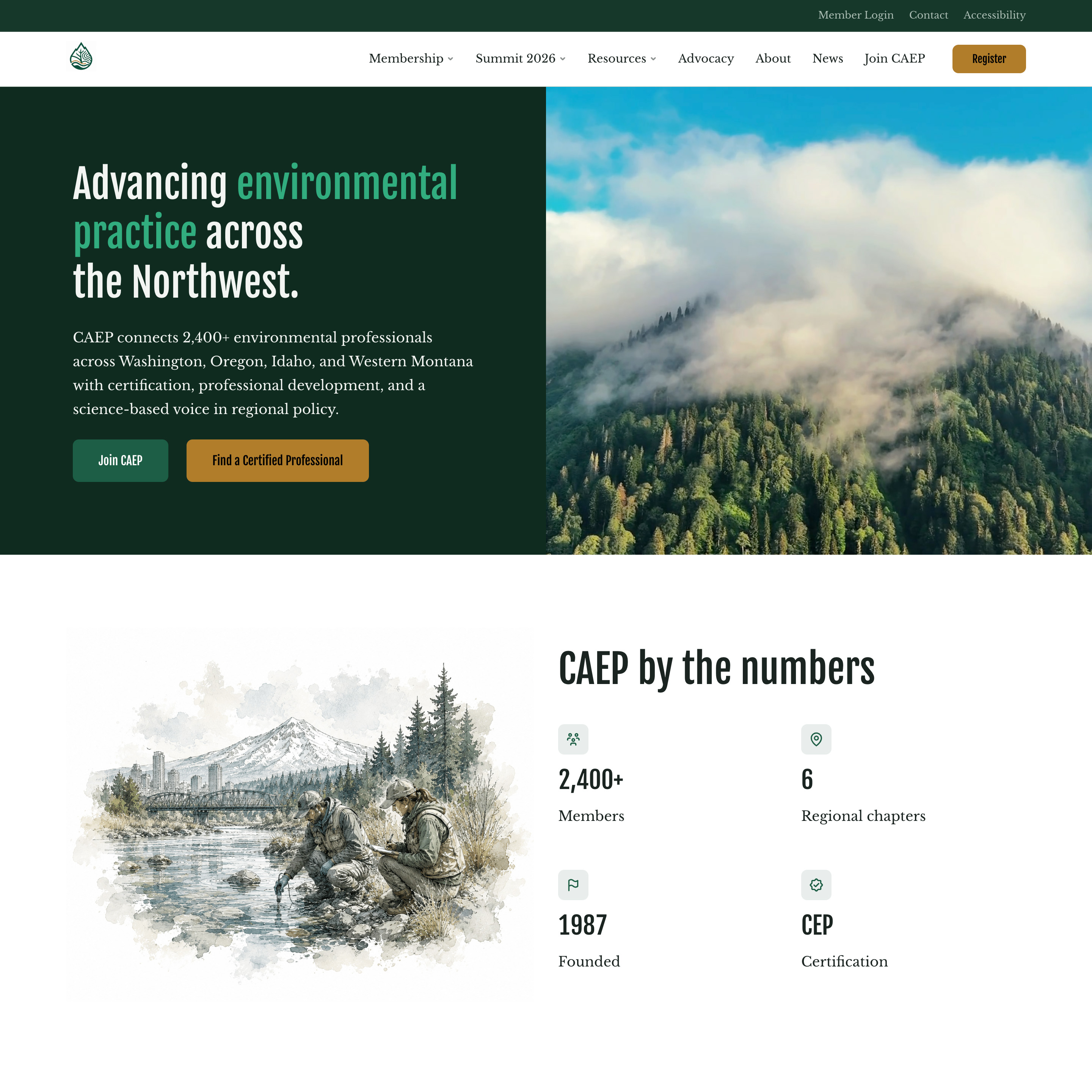
This is the kind of association site agencies bill heavy hours for: a filterable member directory, a full conference microsite (sessions, speakers, tracks, sponsors), a resource library, a job board, regional chapters, and news. Twenty-four pages and 138 structured records, built and deployed in a single sitting with no rebuild. It exists to prove production-grade structured content and accessibility — not “a few pretty pages.”
A real data model, not a pile of pages
Eight custom post types — professionals, chapters, sessions, speakers, sponsors, resources, jobs, and news — with 28 typed fields and 7 relational “groupings,” registered through a validated registry rather than hand-coded per type. This is the relational data layer agencies usually reach for ACF or Pods to assemble.
Relationships that resolve at render time
Bidirectional session↔speaker links, chapter→officers and chapter→members relations, and resource→related-by-topic via taxonomy — all resolved when the page renders and kept migration-safe. Add a speaker once and every session they’re on reflects it; no duplicated, hand-maintained lists.
Faceted directories that stay SEO-clean
The member directory and the conference agenda are server-rendered, faceted archives generated automatically from the field schema. Filter the directory by specialty, region, and credential; filter the agenda by track and level, upcoming versus past (driven by Schema.org Event date logic). The filtered URLs work with JavaScript disabled and stay SEO-clean — noindex plus a canonical back to the base archive, so faceted views never fragment search rankings.
Block content, server-side rendering, one source of truth
Every page is composed of reusable block sections — hero, features, stats, pricing, FAQ, steps, post-grid, gallery — authored as block-format content and rendered in PHP on the front end. A template router hooks template_include at priority 999 and yields to hand-built block pages, so a deliberately designed page always wins over the generic CPT template.
Accessibility as a baseline, not a pass
WCAG 2.2 AA throughout: contrast-verified brand tokens in light and dark modes, one H1 per page, skip links and landmark regions, keyboard-operable filters, real HTML text over hero imagery, and descriptive alt text — fully responsive via design-token theming in theme.json. Five accessible forms, including a two-step call-for-proposals with PDF upload.
Built by an agent, through tooling I engineered
This is the part that’s hard to replicate. The entire build — data model, 138 records, pages, navigation, and forms — was scaffolded and deployed through Model Context Protocol (MCP) connectors I built into the platform: a versioned, permissioned REST surface with preflight, scaffold, and deploy operations, plus safe read-modify-write guarded by optimistic-concurrency tokens. I didn’t just use an AI tool to write code — I built the tooling that lets an AI agent assemble a production WordPress site through a scoped, secure API.
Outcome
A production-ready, fully accessible, structured association site — directory, conference system, resource library, job board, chapters, news, and forms — delivered with zero rebuild and a documented, repeatable build process.
It runs on a suite of custom plugins I designed and built from the ground up as sole engineer: a React + server-side-PHP block builder, a config-driven form runtime, and a custom-post-type renderer. They compose only through published contracts — design tokens, WordPress hooks, and versioned REST — never hard PHP class dependencies, so each can be released on its own cadence without breaking the others.